Sea Thrift or Sea Campion: How to Tell Their Forms Apart
Compare sea thrift and sea campion by leaf shape, growth habit, stems, and flower clusters, so you can identify each coastal plant without relying on color.
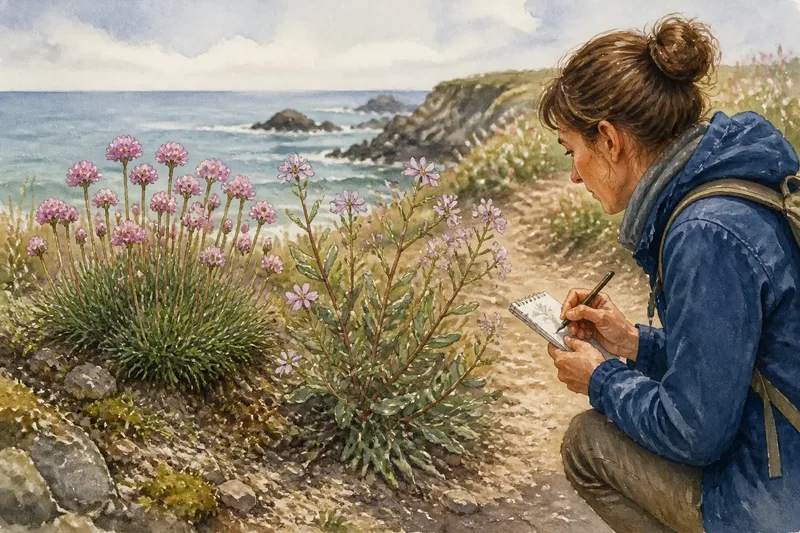
On a coastal path, a pink flower head on a low cushion can look much like another pink flower a few steps away. To tell sea thrift from sea campion, look past color and notice the plant’s overall shape, leaves, stems, and how its flowers sit together. A simple routine across a walk—and, if you revisit, across the growing season—makes those details easier to read.
What should you notice first on a coastal walk?
Start with the plant’s outline before bending close to inspect a flower. Sea thrift usually forms a compact tuft or cushion, with narrow, grasslike leaves packed together near the ground. Its flower stems rise cleanly above that low base, so the rounded heads appear to hover over the foliage.
Sea campion has a looser, branching outline. Its stems spread or lean rather than emerging as a tidy set of upright stalks from a dense cushion. The leaves are still simple and narrow, but the whole plant often reads as an open, leafy mass, with individual flowers distributed along the stems.
Keep your first impression specific: “low cushion with upright flower stems” or “branched plant with spaced blossoms.” Those descriptions are more useful than “pink flowers,” which could fit many coastal plants. If the plant is distant, use binoculars or make a quick sketch of its outline instead of stepping off the path.
How do the leaves and stems differ?
Sea thrift’s leaves are typically narrow, firm-looking, and gathered densely at the base. From a short distance, the foliage can resemble a small grassy mound. The leaves usually do not create a broad leafy backdrop around each flower head; the conspicuous part is the tight basal tuft beneath the bare-looking stems.
Sea campion’s leaves are broader and more noticeable along the stems. They are paired opposite one another at the nodes, giving the stems a leafy, branching appearance. Their edges may look smooth, and the leaves can have a fleshy quality, but avoid touching plants in protected or fragile places just to check texture.
Trace a stem with your eyes from its base to its flowers. A sea thrift stem tends to rise from the tuft and finish in a head; a sea campion stem commonly branches, with leaves and flowers appearing at intervals. That difference remains useful when the flowers are closed or weather-worn.
What does each flower cluster look like?
Sea thrift’s flowers gather into a compact, rounded head at the top of a stalk. Individual small flowers crowd close together, creating a ball or dome-like silhouette. From the side, the head still looks like one dense unit rather than a string of separate blooms.
Sea campion’s flowers are more visibly spaced. Each bloom has five petals, often with a notch at the tip, and a swollen, ribbed-looking calyx behind them. The flowers sit on branched stems rather than forming the characteristic tight globe of sea thrift. A few open blossoms may be separated by visible gaps.
Color can mislead: both plants can bear pale or pinkish flowers, and color changes with light, age, and local conditions. Use it as a supporting clue only after checking the cluster shape and foliage. A phone camera’s close-up can help you inspect a flower later, but include the whole plant in a second frame so the flower is not separated from its growth habit.
How can you make a useful observation routine?
A short routine over one walk is enough to compare the forms; returning during the season can clarify details as buds open and flowers fade. Choose a safe spot on the path where both plants are visible, and record only what you can see without picking, digging, or trampling nearby vegetation.
- At first sight: Note whether the plant forms a low cushion or an open, branched shape.
- From the base: Look for a dense tuft of narrow leaves or leafy stems with leaves spaced along them.
- At the stem: Check whether flower stalks rise simply from the base or branch and carry blossoms at intervals.
- At the flower: Record a compact rounded head or separate five-petaled blooms, and note any notched petal tips.
- On a later visit: Compare the same visible features when more buds have opened or older blooms have faded.
- Before leaving: Save a wide photo and a close photo, or write a brief description that separates shape from color.
Say you see a patch beside a path with pale pink flowers. The plants form leafy, branching stems, and the blooms sit apart rather than gathering into balls; you note those features and take a wide view plus a close view. The expected observable result is a record that points toward sea campion even if the flower color changes in another photograph.
Which questions help when the flowers are hard to see?
Can I identify sea thrift before it flowers?
A dense, low tuft of narrow leaves is a useful clue for sea thrift, especially where sturdy, mostly unbranched stalks rise from the same base. Without flower heads, treat the identification as tentative and note the plant’s form rather than relying on a single trait.
Can sea campion grow in a compact patch?
Yes, neighboring stems can make a patch appear dense from a distance. Look at individual stems within the patch: sea campion still tends to show paired leaves along branching stems and flowers that are not arranged in tight, round heads.
Do flower colors separate the two plants?
No. Color overlaps and can vary, so it is a weak stand-alone clue. Compare leaf placement, branching, and whether the flowers form a dense head or remain separate.
What if the plant is too far away to inspect?
Use binoculars or take a zoomed photograph from the path, then compare the plant’s outline and flower arrangement. If those details remain unclear, record it as an uncertain observation rather than forcing a name.
How should you keep notes without disturbing the plants?
Use a pocket notebook, a phone note, or a photo album with a few plain labels: “cushion,” “branched,” “leaves at base,” “flowers in head,” or “flowers spaced.” Add the coastal setting only as context, not as proof of identity; both plants can occur in exposed seaside habitats, and local conditions vary.
Stay on established paths and avoid handling flowers or removing leaves. If a site has signs about access or plant protection, follow them. Where identification matters for a formal record, consult a local botanical group or a reliable regional field guide, and compare several visible features rather than one photograph.
On your next walk, the quickest sea thrift or sea campion check is to look from the ground up: first the plant’s outline, then leaf placement, then the way flowers gather. A rounded head above a tight tuft suggests sea thrift; branching, leafy stems with distinct blossoms suggest sea campion. Keep the color as a final note, not the deciding one.