Why Pebble Beaches Make Patterns at the Water’s Edge
Why pebble beaches make patterns at the water’s edge becomes clear when you watch waves sort stones into bands, ridges and shifting textures.
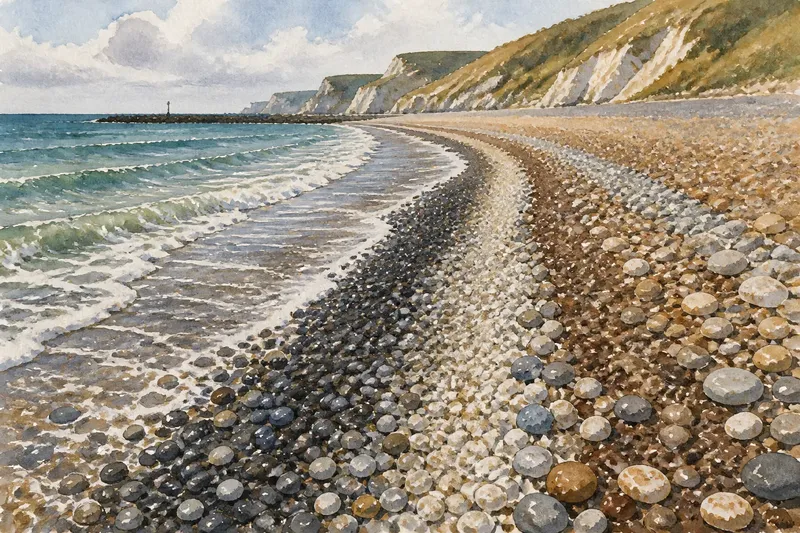
You stop where the wash thins over the pebbles, and a narrow dark band appears, then fades as the next wave slides back. Why pebble beaches make patterns at the water’s edge is easier to see when you watch that small exchange: water moves stones, sorts them, and leaves temporary marks behind.
These patterns are not fixed decorations. They record the latest movement of waves and water, while the shape and mix of stones influence what stays in place. If a band seems confusing or disappears before you can read it, a few simple checks can help you observe it without moving a single pebble.
Why do the stones form bands?
Waves carry pebbles up the beach and draw some of them back. The upward rush can be stronger than the returning flow, so stones are gradually moved toward higher ground. On the way, stones roll, bump and settle where the water loses enough force to carry them farther.
Size, shape and surface all affect how a pebble travels. A flatter stone may slide or lie still where a rounder one rolls; a heavier stone may need stronger water movement to shift. As waves sort these differences, bands of larger, smaller, lighter or darker stones can emerge.
The line between wet and dry stones can add another visible band. Wet pebbles often look darker, so the retreating wash leaves a temporary colour boundary. It may resemble a change in stone type, but watch the water’s edge: if the line moves with each wave, wetness is likely part of the effect.
What if the pattern looks like a jumble?
Problem: every stone seems randomly placed. A close view can hide the larger arrangement, especially where pebbles are mixed in size and color. Try stepping back to a safe, stable spot and tracing one broad stripe across the beach rather than inspecting individual stones.
Problem: a clear band disappears. Incoming waves can cover a line, wet the stones and shift its edges. Wait for the water to draw back, then look at the same patch through several wave cycles. The pattern may reappear in a different position, which is useful evidence that it is active rather than permanent.
Problem: the beach has ridges but no obvious color bands. A raised ridge can mark where waves deposited pebbles, even if the stones have similar colors. Look across the slope for changes in height and texture; a low trough beside a ridge can make the shape easier to recognize.
Problem: several possible explanations seem to fit. A dark stripe might come from wetness, a different stone mix or shade from a nearby feature. Observe whether it changes as waves pass, compare its stones with those immediately above it, and notice whether the stripe follows the waterline or cuts across it.
How can you observe a pebble pattern without disturbing it?
Choose a view from firm ground, away from the reach of waves and any unstable edge. A phone camera can help you compare a pattern over time, but a simple sketch works just as well. Include a fixed landmark, such as a larger boulder or the end of a groyne, so you can find the same area again.
- Pick one feature: follow a dark band, a ridge or a patch of unusually fine stones.
- Watch several waves: note where the wash reaches and where it stops on its return.
- Compare positions: see whether the feature holds its line, shifts uphill or becomes covered.
- Look for texture changes: notice where fine pebbles give way to coarser stones, without sorting them by hand.
- Record the conditions: jot down whether the stones look wet and whether the water is reaching the same part of the beach during your observation.
Say you notice a narrow band of pale stones beside a darker strip. You stay on firm ground and watch as the wash retreats and returns; if the dark strip brightens as it dries while the pale stones stay similar, wetness may explain much of the contrast. If the boundary stays put but the waterline moves, a difference in the stones may also be involved.
What questions help explain a pebble beach?
Why are some pebbles rounder than others?
Repeated collisions and abrasion can wear sharp edges down as stones move. The degree of rounding varies with the stone’s material and the journey it has made, so one beach can contain a range of shapes.
Why do ridges run across the beach?
Waves can push stones up the slope and leave them near the limit of their reach, building a ridge. Several lines may reflect changing water reach, but a single visit cannot tell you exactly when each formed.
Why do pebble patterns change after rough water?
Stronger wave action can move stones that ordinary waves leave settled, reshaping ridges and mixing bands. Afterward, look for freshly exposed patches and altered boundaries rather than expecting the earlier arrangement to remain.
Do pebble bands always show different kinds of stone?
No. A band can be made more visible by moisture, shade or the angle of light, even when the stones are much the same. Compare the stones’ appearance as they dry and check whether the boundary itself moves.
When is a pattern hard to interpret?
Fast-changing water leaves little time to follow a line, and a steep or uneven beach can make a safe viewpoint difficult to find. Watch from a stable place rather than moving closer to the wash for a better view. If the beach is crowded, a photograph from farther back can preserve the broader pattern without blocking others or stepping across it.
Light also changes what you can distinguish. Low-angle light can make small ridges cast visible shadows, while flat light may make the same surface appear smoother. Treat color as one clue among several; shape, wetness and position relative to the waves can be easier to read when color contrast is weak.
What should you notice on your next visit?
For a clearer sense of why pebble beaches make patterns at the water’s edge, follow one feature instead of trying to explain the whole beach at once. Watch where the wave reaches, what the retreat leaves exposed, and whether the feature shifts between cycles. That simple comparison separates a temporary wet line from a more stable arrangement of stones.
Before you leave, look back from the same landmark and note what changed. A moved boundary, a softened ridge or a newly darkened strip gives you a useful record of the shoreline’s activity, while leaving the pebbles exactly where the water placed them.